In the pursuit of the perfect acoustic voice, every single millimeter of a classical guitar matters. While much of the attention in lutherie is rightfully given to the selection of the tonewoods (like the legendary Val di Fiemme Alpine Spruce I use for my soundboards), the mechanics of how the strings interact with that wood are equally crucial.
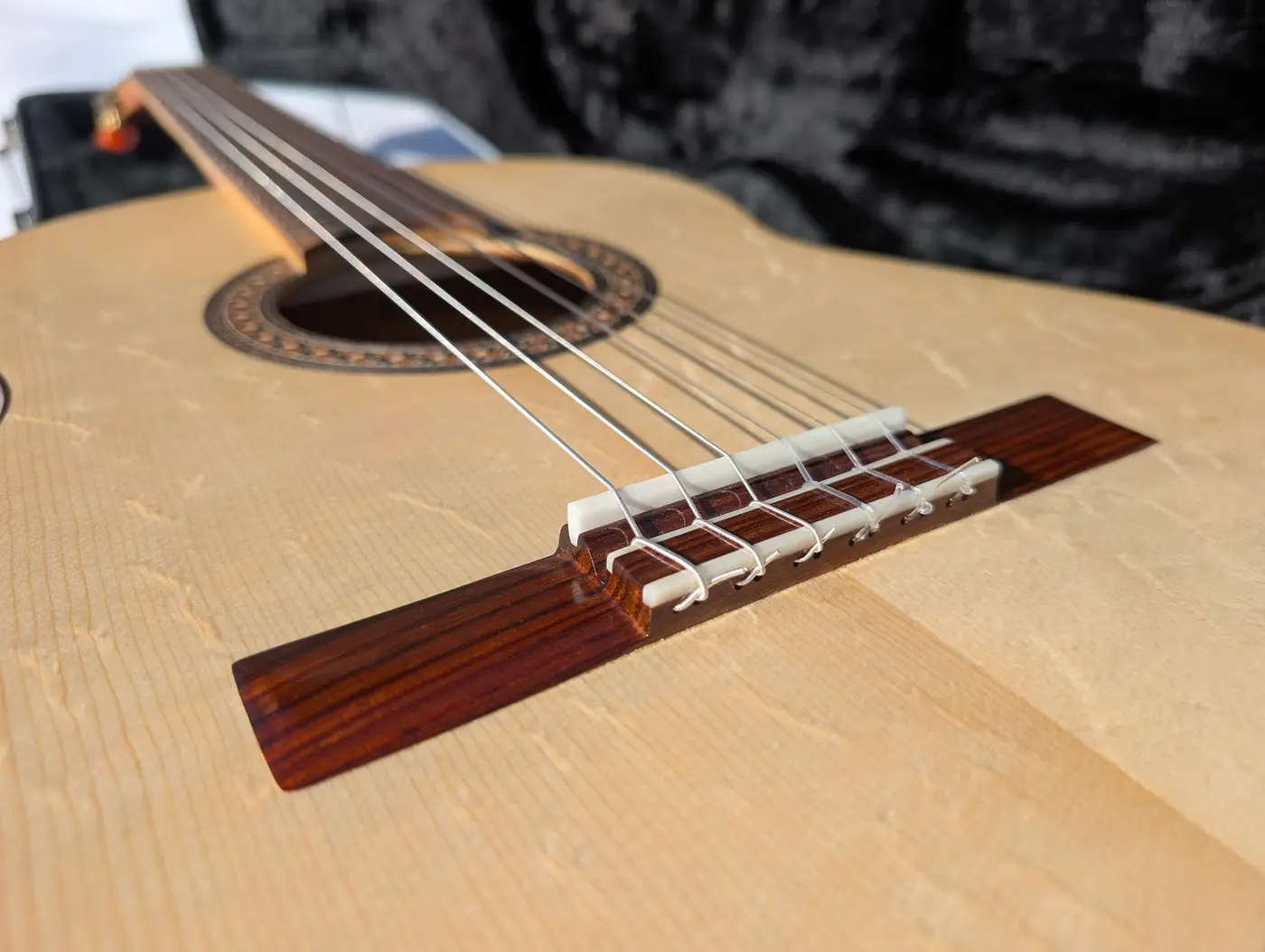
One of the most significant evolutions in modern classical guitar construction is the adoption of the 12-hole tie block on the bridge, a system I proudly implement on Kairòs Lutherie concert models. While the traditional 6-hole bridge has served the instrument for centuries, the 12-hole system offers undeniable mechanical, physical, and acoustic advantages.
Here is why this seemingly small detail drastically transforms the instrument’s performance.
1. The Break Angle and Downward Pressure
The most critical advantage of the 12-hole bridge lies in the “break angle”: the angle at which the string drops from the top of the bone saddle down to the tie block.
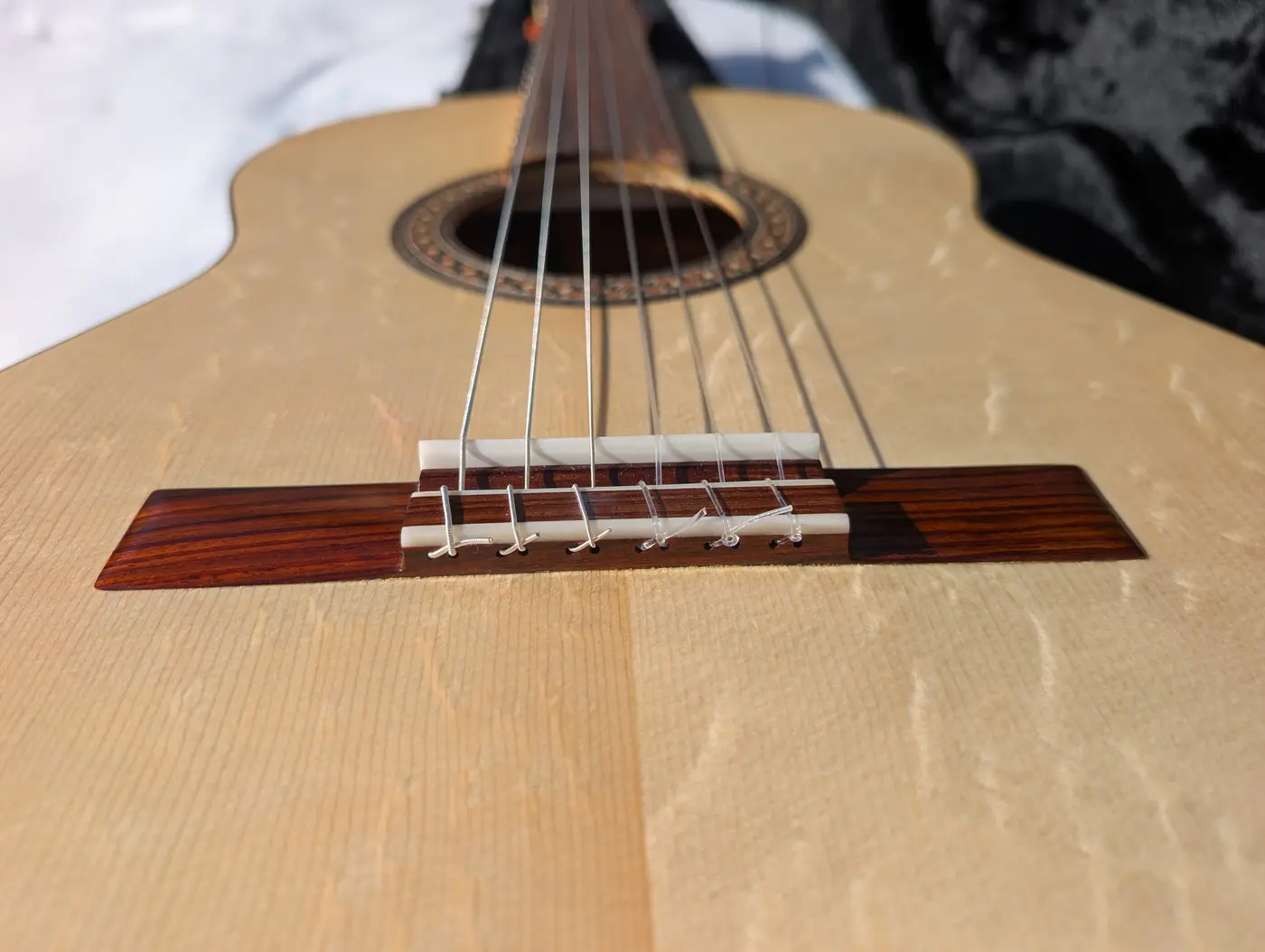
In a traditional 6-hole bridge, the string must loop back under itself to secure the knot. This loop physically pulls the string upward as it leaves the saddle, flattening the break angle. A 12-hole system eliminates this upward pull. Because the string passes through a second hole to lock itself, it travels in a straight, steep downward trajectory from the saddle. This creates a sharper, more consistent break angle, significantly increasing the downward pressure the strings exert on the saddle.
2. Acoustic Efficiency and Tone
What does downward pressure mean for the sound? Everything. The saddle is the main gateway for vibrational energy to transfer from the strings to the soundboard. When the strings are seated firmly with a strong break angle, the transmission of kinetic energy becomes immensely more efficient.
Acoustically, this translates to a faster transient response (a quicker attack), enhanced sustain, and a clearer, more articulate voice. The soundboard is driven with greater power, fully exploiting the dynamic range of the spruce top. It allows a lightly braced, Romanillos-inspired top to truly project with volume and color without losing focus.
3. Tuning Stability
Any classical guitarist knows the frustration of waiting days for new nylon or fluorocarbon strings to settle and hold their tuning. A significant portion of this “stretching” period is actually the knot on the tie block slowly tightening and slipping under tension.
The 12-hole bridge acts as a self-locking mechanism. Because the string weaves through the block twice, the friction is distributed. There is virtually no knot slippage. The result is that fresh strings stabilize and hold their pitch in a fraction of the usual time.
4. Protecting the Soundboard
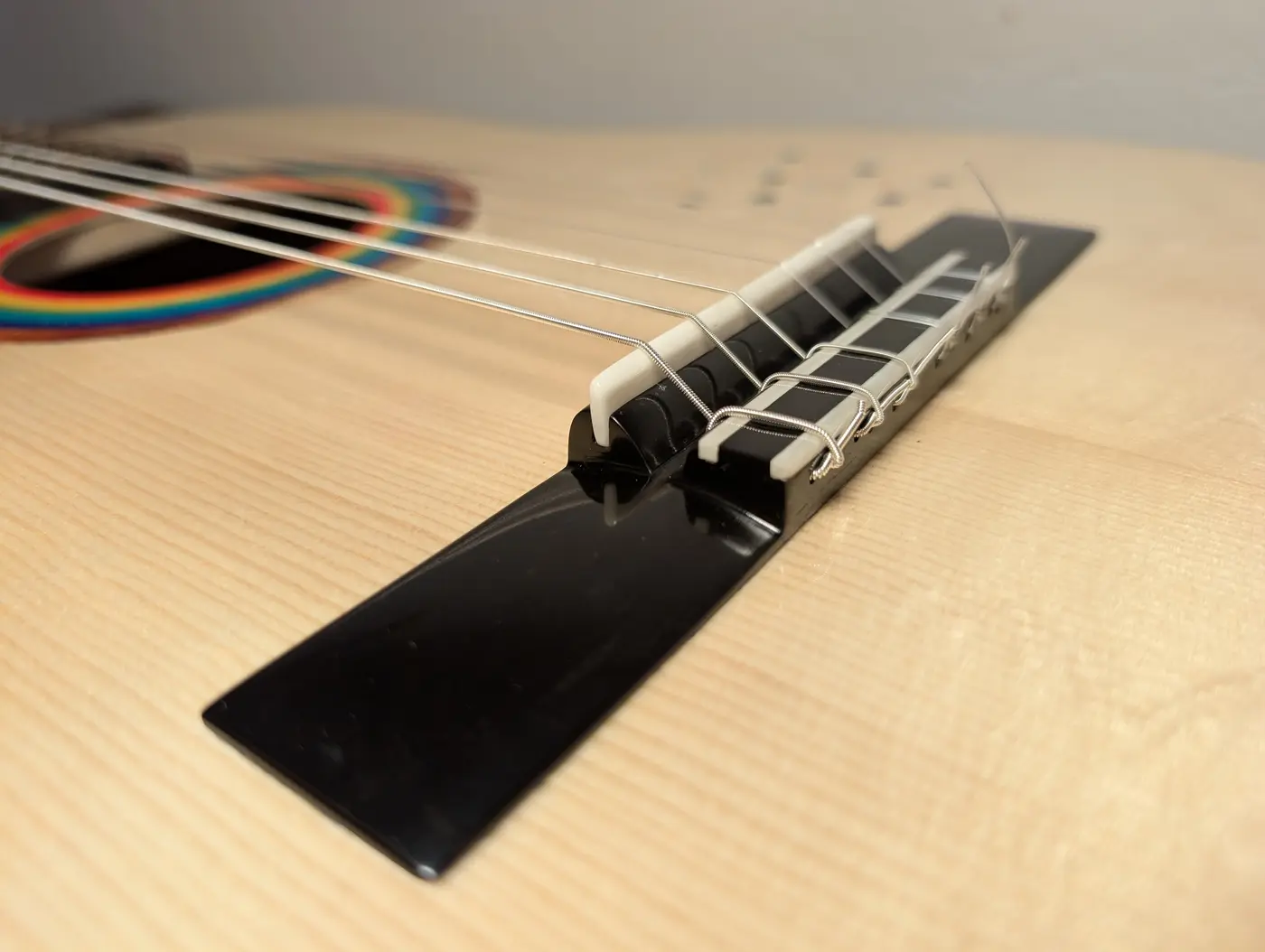
While perhaps less romantic than acoustic physics, the physical safety of the instrument is paramount. Traditional 6-hole knots, especially on the slippery treble strings, are prone to slipping and whipping loose under high tension, causing severe “string dings” (deep scratches and dents) on the soundboard behind the bridge. The 12-hole design effectively eliminates this risk, neatly tucking the string ends securely away and pointing them upward, keeping the delicate French Polish finish completely safe from harm.
A Philosophy of Efficiency
At Kairòs Lutherie, my goal is to build instruments that offer no resistance to the player’s musical intent. The 12-hole bridge is not a mere aesthetic choice; it is an engineering solution that maximizes acoustic efficiency, structural safety, and tuning stability. It ensures that every ounce of energy your fingers put into the strings is translated into pure, unhindered music.