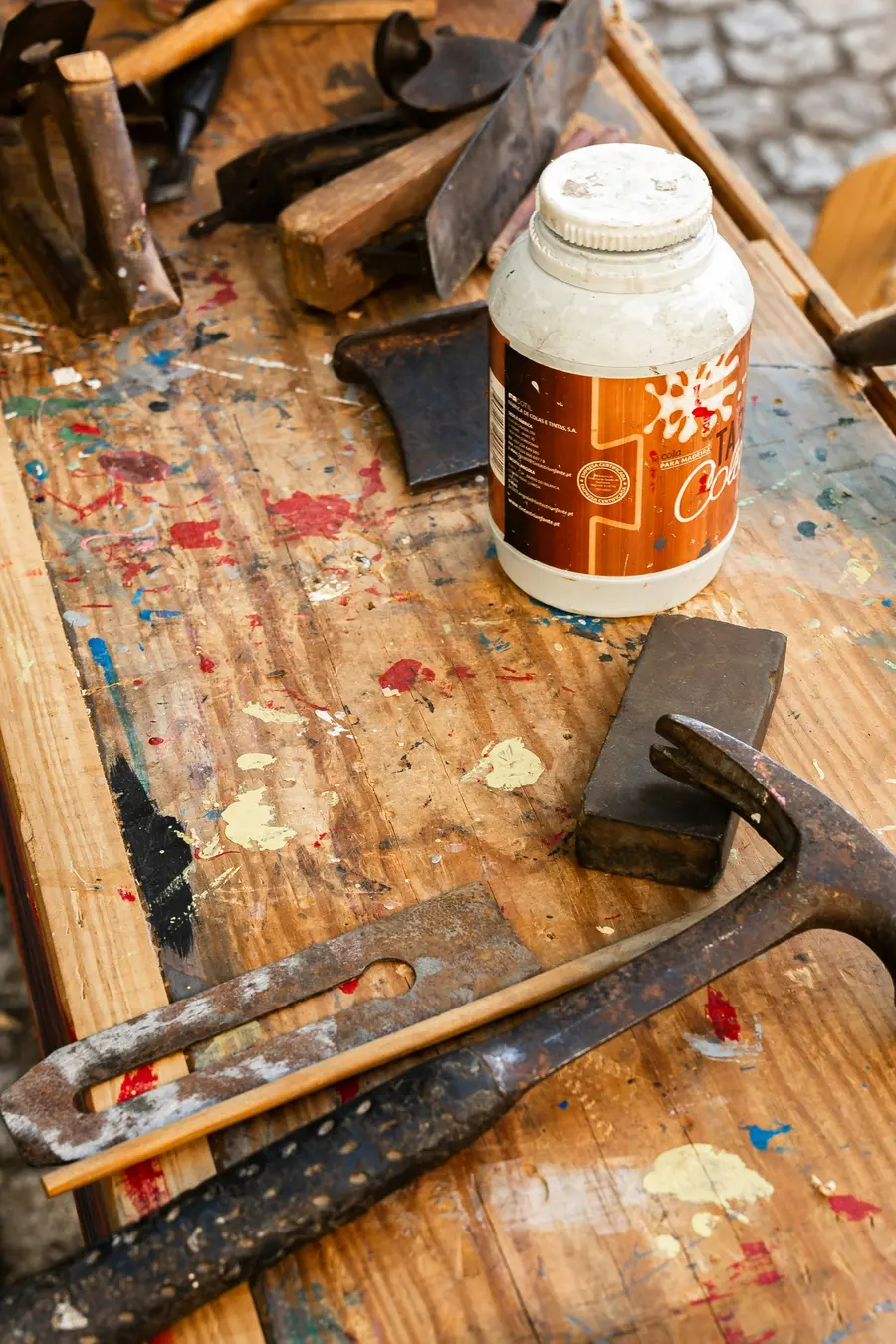
At Kairòs Lutherie, I often explain that a master-built guitar is a mechanical transducer designed to convert kinetic energy into sound waves. In this ecosystem, gluing is never just a structural necessity; it is acoustic engineering. Every joint in the instrument acts as a potential acoustic filter. There is no single “perfect” glue in an absolute sense: only the thermodynamically and mechanically correct adhesive for a specific interface.
Aliphatic Resins: The Acoustic Standard
When I build a classical guitar, I almost exclusively reach for aliphatic resin. This traditional yellow wood glue is the backbone of modern lutherie.
The Application: I use it for the vast majority of high-tolerance wood-to-wood structural joints, including joining the two halves of an Alpine Spruce soundboard, locking down the bracing, and setting the neck. There is a palpable tension at the workbench when using it, as I only have a brief five-minute open window to perfectly align the pieces and set the clamps.
The Engineering Advantage: As the water within it evaporates, it crystallizes into an extremely rigid bond. That rigidity is crucial: it minimizes internal damping, allowing a seamless transfer of kinetic energy between the components. The joint resists the constant, static pulling tension of the strings without creeping, while still remaining reversible with heat and moisture should a future restoration be necessary.
Epoxy Resins: Cohesive Strength and Composites
When I need to create a structural monolith out of disparate materials, I switch to two-part epoxy systems, relying on a violent exothermic reaction to create three-dimensional cross-linked polymers.
The Application: I rely on epoxy for extreme structural joints and multi-material unions. This includes inlaying carbon fiber reinforcement rods into a neck, laminating complex veneers, or joining highly resinous, exotic tonewoods like Honduran Rosewood where water-based glues would simply fail to adhere.
The Engineering Advantage: Because epoxy is 100% solids, it undergoes zero dimensional shrinkage as it cures. It introduces no water into the joint, preventing any localized swelling of the wood in critical areas. It provides exceptional gap-filling capabilities, transforming complex, multi-material joints into unified, indestructible anchors.
Polyurethane Adhesives: Hygroscopic Expansion
For entirely different mechanical challenges, I look to polyurethane adhesives, which cure through a hygroscopic reaction by drawing moisture directly from the air and the wood’s own cells.
The Application: I use polyurethane for complex purfling and binding work, or when joining highly porous surfaces that require absolute, long-term impermeability and structural cohesion.
The Engineering Advantage: The primary engineering asset here is its expansion. As it cures, the resin gently foams, driving itself aggressively into the microscopic pores of the wood. It creates a hermetic seal and a profound mechanical root, curing into a totally inert barrier that resists heat, moisture, and chemical solvents.
Cyanoacrylate (CA): Capillarity and Fluid Dynamics
Cyanoacrylate is the surgical precision tool of my workshop, polymerizing almost instantaneously in the presence of trace moisture.
The Application: When I am firmly seating frets into their slots, installing mother-of-pearl inlays, or stabilizing a delicate nut slot, CA glue is my scalpel. I also use it for microscopic cosmetic drop-fills on finishes or open wood pores.
The Engineering Advantage: Its greatest asset is not just its rapid cure time, but its capillary action. Using a water-thin variant, I can watch it disappear in a fraction of a second, pulled by surface tension deep into microscopic, invisible crevices. It is irreplaceable for impregnating and consolidating fragile or spongy wood fibers, locally transforming the organic cellular structure into a rigid acrylic composite that I can scrape, sand, and polish to an absolute mirror finish.